

🤖 Increase your productiveness with AI! Discover Quso: all-in-one AI social media suite for sensible automation.
For many years, digital conferences have lived inside a rectangle. Regardless of how superior the know-how turned, collaboration was confined to grids, panels, and toolbars on a flat display. With Webex for Apple Imaginative and prescient Professional, our group got down to reimagine that paradigm by designing for house as a substitute of screens. Alongside designers Alex Brown and Shaun Steenson, we explored how spatial computing may make distant work really feel like working collectively once more. This human-centered method not solely reshaped how we take into consideration presence and interplay. It additionally earned Webex for Apple Imaginative and prescient Professional the distinguished iF Design Award, recognizing our dedication to readability, usability, and innovation in enterprise collaboration.
To attain this, we first needed to rethink probably the most elementary assumption in collaboration design: the rectangle.
From Rectangles to House
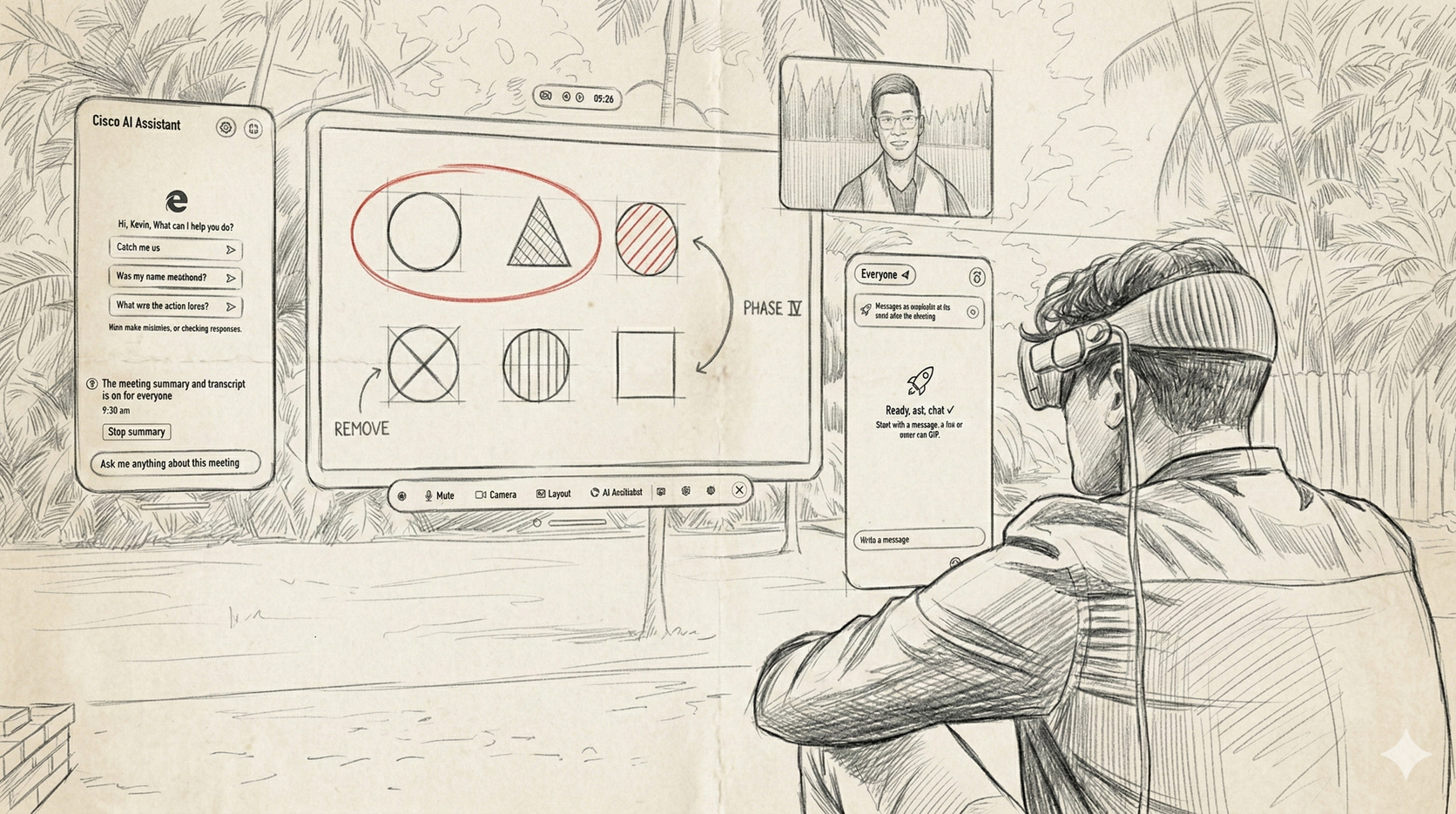
The most important assumption we needed to unlearn was designing for a body. Conventional assembly experiences are optimized for rectangles — bounded home windows with mounted edges, predictable hierarchies, and a single focal airplane. In spatial computing, that boundary disappears. As a substitute of arranging pixels, we design for depth, distance, eye line, attain, and bodily consolation.
This shift reframes the designer’s job. Consideration is now not purely visible; it turns into environmental. The place content material sits in house, how far it’s from the person, the way it layers with different components, and the way it responds to motion all affect focus, comprehension, and fatigue. A window positioned too shut feels intrusive. Content material too distant turns into disengaging. Overlapping layers can create cognitive friction as a substitute of readability.
Designing for house introduces a brand new set of issues to resolve:
- Spatial hierarchy: What deserves to be foreground vs. peripheral?
- Ergonomics: How will we stop neck pressure, eye fatigue, and attain discomfort over lengthy periods?
- Depth administration: When does layering add that means versus confusion?
- Consideration move: How do customers know the place to look with out pressured cues?
- Environmental concord: How do digital components coexist with the bodily room as a substitute of combating it?
- Recoverability: How can customers shortly restore order when their workspace turns into cluttered?
Not like 2D layouts, spatial environments are dynamic and user-controlled. Folks can stroll round content material, resize it, pin it to surfaces, or push it apart. This implies designers can’t depend on mounted layouts to protect readability. We should create techniques that stay legible and comfy regardless of how the house is rearranged.
Framing the issue this manner allowed the subsequent design choices to fall into place. If spatial computing removes the rectangle, the objective is to not fill the room — it’s to create space usable, comprehensible, and calm.
Designing Calm in a Spatial Atmosphere
Spatial interfaces can develop into chaotic shortly. Floating home windows, layered depth, and movement can overwhelm customers if not dealt with fastidiously. Our design method prioritized readability over spectacle, making certain the surroundings helps focus slightly than distraction.
We used impartial panels, delicate shadows, and pure depth cues so home windows really feel anchored as a substitute of intrusive. Glass supplies that react to the encompassing surroundings assist UI components really feel like they belong within the room, slightly than sitting on high of it.
To forestall cognitive overload, spatial complexity is launched step by step. Customers start with a well-known windowed interface and may transfer towards a extra immersive, windowless expertise at their very own tempo. They retain full management over how a lot house they use and the way their workspace is organized. Options like pinning home windows to surfaces and immediately hiding content material enable customers to revive order at any time.
Our guiding rule was easy: use house solely when it provides readability. In any other case, preserve it calm.
Managing and Interacting with 3D Fashions in Actual Workflows
As soon as the spatial surroundings felt calm and legible, the subsequent problem was enabling significant interplay with 3D content material. Designing for 3D content material required balancing intuitive interplay with sensible workflows. Whereas spatial computing permits dramatic manipulation of fashions, usability will depend on aligning with pure human habits and present work patterns.
Testing revealed that regardless that oblique gestures utilizing eyes and palms are supported, individuals instinctively reached out to seize 3D fashions as they might in actual life. To make interactions extra intuitive, we supported each direct and oblique gestures and launched customized one-handed gestures to enhance pace and accessibility.
Eye monitoring performed a essential function. With out exact hover states and appropriately sized interplay targets, the expertise turns into irritating. We ensured the interface responds predictably to the place customers look, making mannequin choice and manipulation really feel dependable and pure.
We additionally aligned mannequin sharing with actual workflows. Early ideas assumed customers would add 3D fashions instantly from the headset, however testing confirmed that the majority fashions stay on desktop techniques. We launched seamless sharing from desktop into spatial conferences, making certain hybrid groups can collaborate successfully. A shared 3D mannequin in spatial computing should nonetheless render meaningfully in 2D so contributors becoming a member of from laptops can perceive and contribute.
By grounding 3D interplay in acquainted behaviors and real-world workflows, spatial collaboration turns into sensible, not experimental.
Acknowledged for Design Excellence
These design choices weren’t made for novelty or awards. They have been pushed by a perception that collaboration know-how ought to adapt to individuals, not the opposite means round. Nonetheless, it was an honor to see this work acknowledged with the iF Design Award, one of many world’s most revered design distinctions.
The award validates our concentrate on readability, human-centered interplay, and considerate integration of spatial computing into actual workflows. Extra importantly, it indicators that enterprise collaboration will be each highly effective and superbly designed.
A New Period of Collaboration
Webex for Apple Imaginative and prescient Professional represents greater than a brand new interface. It indicators a shift in how we take into consideration collaboration itself. By transferring past the flat display and designing for human habits in house, we are able to restore presence, enhance focus, and allow new types of teamwork.
This work additionally displays a broader dedication. Investing in spatial computing shouldn’t be about chasing novelty. It’s about reimagining collaboration so know-how fades into the background and folks can join extra naturally.
The way forward for conferences shouldn’t be confined to a rectangle. It’s all round us.
Study extra:
Webex for Apple Imaginative and prescient Professional
3D Mannequin Collaboration on Webex for Apple Imaginative and prescient Professional
Webex for Apple Imaginative and prescient Professional on Apple App Retailer
🚀 Stage up your duties with GetResponse AI-powered instruments to streamline your workflow!

