

🚀 Able to supercharge your AI workflow? Strive ElevenLabs for AI voice and speech technology!
On this article, you’ll discover ways to implement a context pruning pipeline for long-running AI brokers, enabling them to handle conversational reminiscence effectively by means of semantic similarity.
Matters we’ll cowl embrace:
- Why unbounded dialog historical past is an issue for brokers constructed on high of enormous language fashions, and what a context pruning technique appears to be like like.
- The right way to use sentence transformer embedding fashions to compute semantic similarity between a present immediate and archived dialog turns.
- The right way to assemble a pruned context window from the newest flip, the top-Ok semantically related previous turns, and the present immediate.
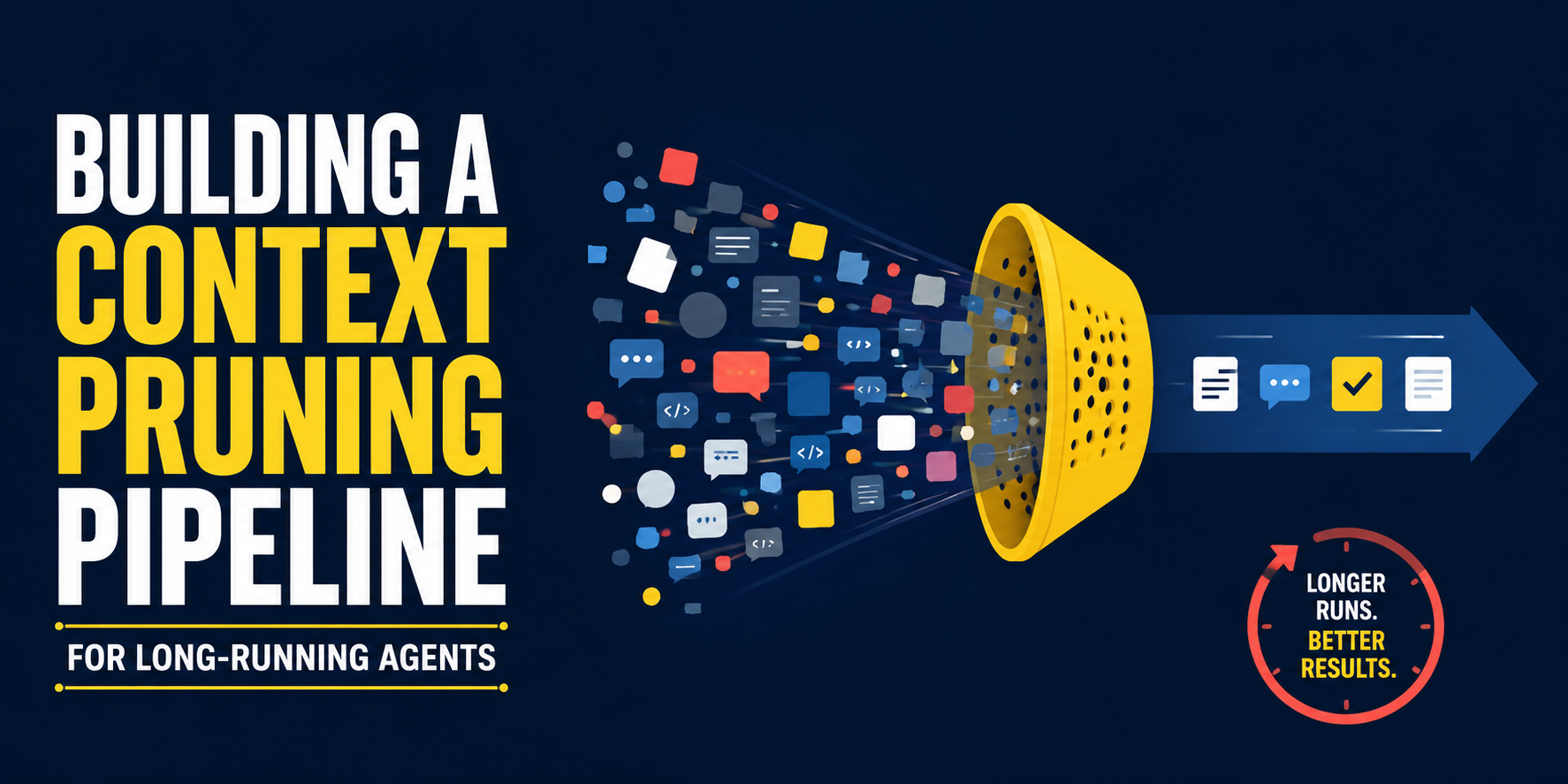
Constructing a Context Pruning Pipeline for Lengthy-Operating Brokers
Introduction
Trendy AI brokers constructed on high of enormous language fashions (LLMs) are designed to run repeatedly. Because of this, their dialog historical past retains rising indefinitely. Passing such a whole historical past because the LLM’s context window is the right recipe for prohibitive token prices, latency bottlenecks, and eventual degradation in reasoning.
Constructing a context pruning pipeline can deal with this situation by dynamically managing latest conversational reminiscence. This text outlines the essential ideas for implementing a context pruning pipeline for long-running brokers.
We use a wholly accessible and free-to-run native answer primarily based on open-source embedding fashions slightly than paid APIs, however you possibly can substitute them with paid APIs if you need a extra environment friendly answer.
Proposed Reminiscence Technique
Classical reminiscence methods in brokers depend on a sliding window that forgets previous data because it falls behind, together with doubtlessly vital particulars. Transferring past that strategy, it’s doable to construct a selective, smarter pipeline that offers the LLM exactly what it wants as context.
In essence, the context might be pruned right down to the next fundamental parts:
- The present immediate, containing the person’s request or query.
- The most up-to-date flip, i.e. the instant earlier input-response change, which is essential to sustaining conversational continuity.
- The top-Ok semantically related matches, calculated primarily based on a similarity rating. These are previous turns carefully associated to the present immediate, retrieved by means of vector embeddings.
Every thing within the dialog historical past that falls outdoors the scope of those three parts is discarded from the energetic immediate’s context, saving compute and reminiscence.
Simulation-Primarily based Implementation
Our instance implementation simulates the applying of the aforementioned technique, constructing a context pruning window step-by-step. Sentence transformer fashions are used to simulate a long-running pipeline alongside a mocked dialog historical past.
We begin by making the required imports:
|
import numpy as np from sentence_transformers import SentenceTransformer from scipy.spatial.distance import cosine |
Subsequent, we load and initialize a pre-trained embedding mannequin — concretely all-MiniLM-L6-v2 from the sentence_transformers library. This mannequin has been educated to rework uncooked textual content into embedding vectors that seize semantic traits. We additionally create a easy, simulated agent historical past containing user-agent interactions (in an actual setting, this is able to be fetched from a database):
|
# Initialize a light-weight open-source embedding mannequin mannequin = SentenceTransformer(‘all-MiniLM-L6-v2’)
# 1. Simulated Agent Historical past (Normally fetched from a database) chat_history = [ {“role”: “user”, “content”: “My name is Alice and I work in logistics.”}, {“role”: “agent”, “content”: “Nice to meet you, Alice. How can I help with logistics?”}, {“role”: “user”, “content”: “What’s the weather like today?”}, {“role”: “agent”, “content”: “It’s sunny and 75 degrees.”}, {“role”: “user”, “content”: “I need help calculating route efficiency for my fleet.”}, {“role”: “agent”, “content”: “Route efficiency involves analyzing distance, traffic, and load weight.”}, {“role”: “user”, “content”: “Thanks, that makes sense.”}, {“role”: “agent”, “content”: “You’re welcome! Let me know if you need anything else.”} ] |
The core logic of the context pruning pipeline comes subsequent. It’s encapsulated in a prune_context() operate that receives the present immediate, the complete interplay historical past, and the variety of semantically related previous turns to retrieve, okay:
|
1 2 3 4 5 6 7 8 9 10 11 12 13 14 15 16 17 18 19 20 21 22 23 24 25 26 27 28 29 30 31 32 33 |
def prune_context(current_prompt, historical past, top_k=2): # If the dialog historical past is just too quick, we merely return it if len(historical past) <= 2: return historical past + [{“role”: “user”, “content”: current_prompt}]
# Extracting the newest flip (final person/agent pair) recent_turn = historical past[–2:]
# The remainder of the historical past can be eligible for semantic pruning archived_turns = historical past[:–2]
# 2. Embedding the present immediate prompt_emb = mannequin.encode(current_prompt)
# 3. Embedding archived turns and computing similarities scored_turns = [] for flip in archived_turns: turn_emb = mannequin.encode(flip[“content”]) # We wish similarity, so we subtract cosine distance from 1 similarity = 1 – cosine(prompt_emb, turn_emb) scored_turns.append((similarity, flip))
# 4. Sorting by highest similarity and slicing the Prime-Ok turns scored_turns.kind(key=lambda x: x[0], reverse=True) top_semantic_turns = [turn for score, turn in scored_turns[:top_k]]
# Sorting the semantic turns chronologically (non-compulsory however really helpful for LLMs) top_semantic_turns.kind(key=lambda x: archived_turns.index(x))
# 5. Assemble the ultimate pruned context pruned_context = top_semantic_turns + recent_turn + [{“role”: “user”, “content”: current_prompt}]
return pruned_context |
The above code is essentially self-explanatory. It divides the logic right into a base case — when the dialog historical past continues to be too quick, wherein case the entire historical past is handed as context — and a basic case, wherein the precise semantic pruning pipeline takes place by means of a number of steps: embedding previous turns, calculating cosine similarities with the present immediate embedding, sorting them from highest to lowest similarity, and choosing the top-Ok previous turns. The present immediate, the newest flip, and the top-Ok semantically comparable previous turns are lastly assembled right into a pruned context.
The next instance illustrates methods to receive the context for a brand new immediate wherein the person returns to facets associated to fleet route effectivity:
|
# Simulation Execution current_request = “Can we return to the fleet math?” optimized_context = prune_context(current_request, chat_history)
# Output the outcome print(“— PRUNED CONTEXT WINDOW —“) for msg in optimized_context: print(f“{msg[‘role’].higher()}: {msg[‘content’]}”) |
The ensuing context window produced by our pruning technique is proven beneath:
|
—– PRUNED CONTEXT WINDOW —– USER: I want assist calculating route effectivity for my fleet. AGENT: Route effectivity entails analyzing distance, visitors, and load weight. USER: Thanks, that makes sense. AGENT: You‘re welcome! Let me know if you want something else. USER: Can we go again to the fleet math? |
Be aware that we used the default worth for okay, i.e. top_k=2. The final flip, which is at all times included in our outlined pipeline, consists of the message pair:
|
USER: Thanks, that makes sense. AGENT: You‘re welcome! Let me know if you want something else. |
So why does just one extra user-agent interplay seem earlier than this flip, slightly than two? The reason being that the top-k technique doesn’t function on the full flip stage (i.e. a pair of messages), however on the particular person message stage. On this case, the 2 retrieved messages primarily based on similarity occur to kind the 2 halves of the identical interplay, however it’s equally doable for the 2 most related messages to be each person messages, each agent messages, or just non-consecutive elements of the chat historical past.
Wrapping Up
This text demonstrated methods to implement a context pruning pipeline — primarily based on a simulated agent dialog historical past — that depends on semantic similarity to pick essentially the most related elements of a dialog as context for the present immediate. This is a crucial approach for long-running brokers, serving to to scale back reminiscence utilization and computation prices whereas enhancing general effectivity.
🔥 Need the very best instruments for AI advertising and marketing? Try GetResponse AI-powered automation to spice up your corporation!
