

🚀 Able to supercharge your AI workflow? Attempt ElevenLabs for AI voice and speech technology!
On this article, you’ll learn to construct an area, privacy-first tool-calling agent utilizing the Gemma 4 mannequin household and Ollama.
Subjects we’ll cowl embrace:
- An outline of the Gemma 4 mannequin household and its capabilities.
- How software calling permits language fashions to work together with exterior capabilities.
- Find out how to implement an area software calling system utilizing Python and Ollama.
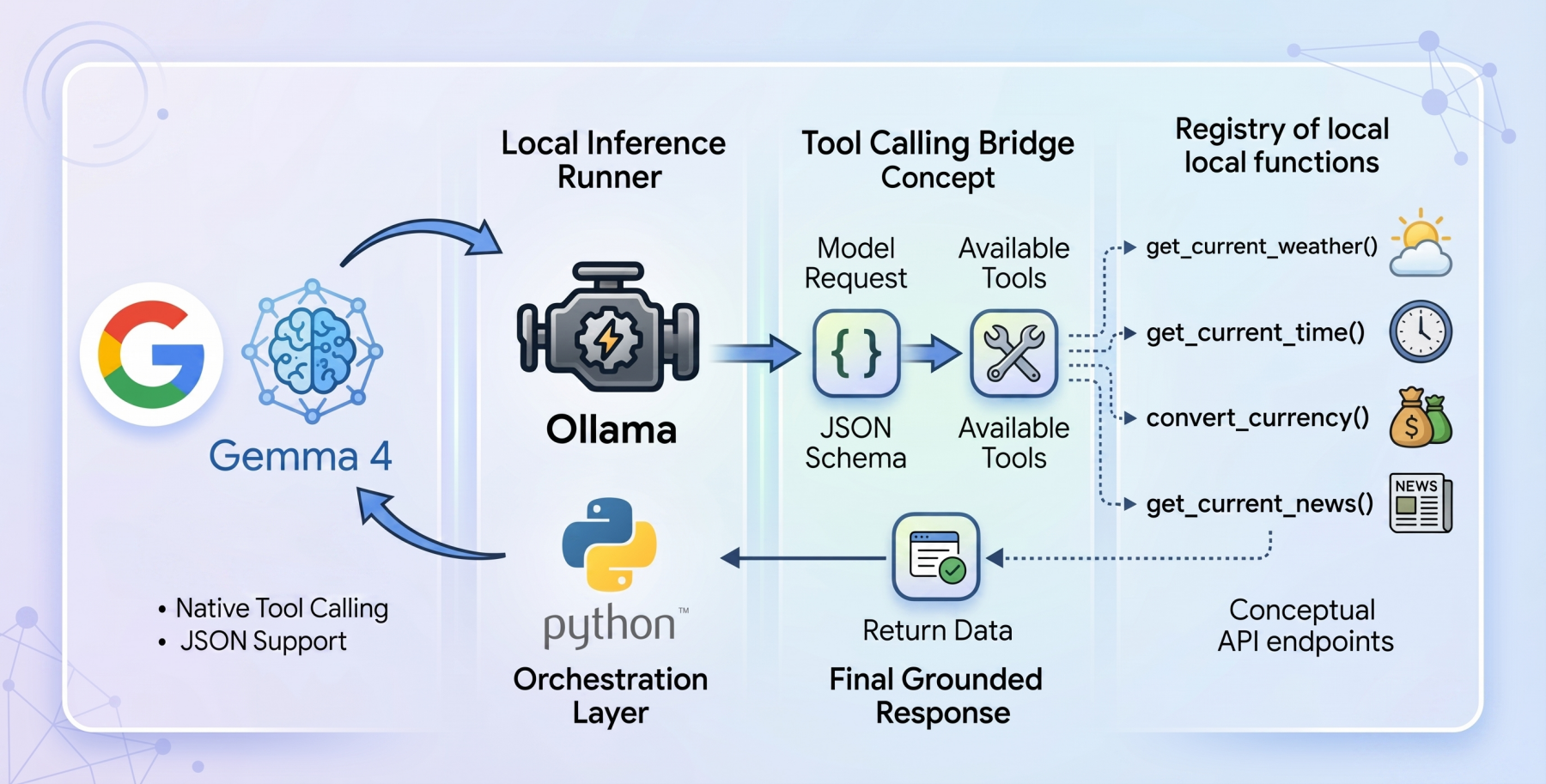
Find out how to Implement Device Calling with Gemma 4 and Python
Picture by Editor
Introducing the Gemma 4 Household
The open-weights mannequin ecosystem shifted just lately with the discharge of the Gemma 4 mannequin household. Constructed by Google, the Gemma 4 variants have been created with the intention of offering frontier-level capabilities below a permissive Apache 2.0 license, enabling machine studying practitioners full management over their infrastructure and knowledge privateness.
The Gemma 4 launch options fashions starting from the parameter-dense 31B and structurally advanced 26B Combination of Consultants (MoE) to light-weight, edge-focused variants. Extra importantly for AI engineers, the mannequin household options native assist for agentic workflows. They’ve been fine-tuned to reliably generate structured JSON outputs and natively invoke perform calls based mostly on system directions. This transforms them from “fingers crossed” reasoning engines into sensible methods able to executing workflows and conversing with exterior APIs regionally.
Device Calling in Language Fashions
Language fashions started life as closed-loop conversationalists. Should you requested a language mannequin for real-world sensor studying or reside market charges, it might at greatest apologize, and at worst, hallucinate a solution. Device calling, aka perform calling, is the foundational structure shift required to repair this hole.
Device calling serves because the bridge that may assist rework static fashions into dynamic autonomous brokers. When software calling is enabled, the mannequin evaluates a consumer immediate in opposition to a supplied registry of accessible programmatic instruments (equipped through JSON schema). Reasonably than trying to guess the reply utilizing solely inside weights, the mannequin pauses inference, codecs a structured request particularly designed to set off an exterior perform, and awaits the end result. As soon as the result’s processed by the host software and handed again to the mannequin, the mannequin synthesizes the injected reside context to formulate a grounded ultimate response.
The Setup: Ollama and Gemma 4:E2B
To construct a genuinely native, private-first software calling system, we’ll use Ollama as our native inference runner, paired with the gemma4:e2b (Edge 2 billion parameter) mannequin.
The gemma4:e2b mannequin is constructed particularly for cell units and IoT purposes. It represents a paradigm shift in what is feasible on client {hardware}, activating an efficient 2 billion parameter footprint throughout inference. This optimization preserves system reminiscence whereas reaching near-zero latency execution. By executing totally offline, it removes price limits and API prices whereas preserving strict knowledge privateness.
Regardless of this extremely small dimension, Google has engineered gemma4:e2b to inherit the multimodal properties and native function-calling capabilities of the bigger 31B mannequin, making it a really perfect basis for a quick, responsive desktop agent. It additionally permits us to check for the capabilities of the brand new mannequin household with out requiring a GPU.
The Code: Setting Up the Agent
To orchestrate the language mannequin and the software interfaces, we’ll depend on a zero-dependency philosophy for our implementation, leveraging solely customary Python libraries like urllib and json, making certain most portability and transparency whereas additionally avoiding bloat.
The entire code for this tutorial may be discovered at this GitHub repository.
The architectural circulation of our software operates within the following method:
- Outline native Python capabilities that act as our instruments
- Outline a strict JSON schema that explains to the language mannequin precisely what these instruments do and what parameters they anticipate
- Go the consumer’s question and the software registry to the native Ollama API
- Catch the mannequin’s response, determine if it requested a software name, execute the corresponding native code, and feed the reply again
Constructing the Instruments: get_current_weather
Let’s dive into the code, maintaining in thoughts that our agent’s functionality rests on the standard of its underlying capabilities. Our first perform is get_current_weather, which reaches out to the open-source Open-Meteo API to resolve real-time climate knowledge for a particular location.
|
1 2 3 4 5 6 7 8 9 10 11 12 13 14 15 16 17 18 19 20 21 22 23 24 25 26 27 28 29 30 31 32 33 34 35 36 37 |
def get_current_weather(metropolis: str, unit: str = “celsius”) -> str: “”“Will get the present temperature for a given metropolis utilizing open-meteo API.”“” attempt: # Geocode town to get latitude and longitude geo_url = f“https://geocoding-api.open-meteo.com/v1/search?title={urllib.parse.quote(metropolis)}&depend=1” geo_req = urllib.request.Request(geo_url, headers={‘Consumer-Agent’: ‘Gemma4ToolCalling/1.0’}) with urllib.request.urlopen(geo_req) as response: geo_data = json.masses(response.learn().decode(‘utf-8’))
if “outcomes” not in geo_data or not geo_data[“results”]: return f“Couldn’t discover coordinates for metropolis: {metropolis}.”
location = geo_data[“results”][0] lat = location[“latitude”] lon = location[“longitude”] nation = location.get(“nation”, “”)
# Fetch the climate temp_unit = “fahrenheit” if unit.decrease() == “fahrenheit” else “celsius” weather_url = f“https://api.open-meteo.com/v1/forecast?latitude={lat}&longitude={lon}&present=temperature_2m,wind_speed_10m&temperature_unit={temp_unit}” weather_req = urllib.request.Request(weather_url, headers={‘Consumer-Agent’: ‘Gemma4ToolCalling/1.0’}) with urllib.request.urlopen(weather_req) as response: weather_data = json.masses(response.learn().decode(‘utf-8’))
if “present” in weather_data: present = weather_data[“current”] temp = present[“temperature_2m”] wind = present[“wind_speed_10m”] temp_unit_str = weather_data[“current_units”][“temperature_2m”] wind_unit_str = weather_data[“current_units”][“wind_speed_10m”]
return f“The present climate in {metropolis.title()} ({nation}) is {temp}{temp_unit_str} with wind speeds of {wind}{wind_unit_str}.” else: return f“Climate knowledge for {metropolis} is unavailable from the API.”
besides Exception as e: return f“Error fetching climate for {metropolis}: {e}” |
This Python perform implements a two-stage API decision sample. As a result of customary climate APIs usually require strict geographical coordinates, our perform transparently intercepts town string supplied by the mannequin and geocodes it into latitude and longitude coordinates. With the coordinates formatted, it invokes the climate forecast endpoint and constructs a concise pure language string representing the telemetry level.
Nonetheless, writing the perform in Python is barely half the execution. The mannequin must be knowledgeable visually about this software. We do that by mapping the Python perform into an Ollama-compliant JSON schema dictionary:
|
1 2 3 4 5 6 7 8 9 10 11 12 13 14 15 16 17 18 19 20 21 |
{ “kind”: “perform”, “perform”: { “title”: “get_current_weather”, “description”: “Will get the present temperature for a given metropolis.”, “parameters”: { “kind”: “object”, “properties”: { “metropolis”: { “kind”: “string”, “description”: “Town title, e.g. Tokyo” }, “unit”: { “kind”: “string”, “enum”: [“celsius”, “fahrenheit”] } }, “required”: [“city”] } } } |
This inflexible structural blueprint is crucial, because it explicitly particulars variable expectations, strict string enums, and required parameters, all of which information the gemma4:e2b weights into reliably producing syntax-perfect calls.
Device Calling Beneath the Hood
The core of the autonomous workflow occurs primarily inside the primary loop orchestrator. As soon as a consumer points a immediate, we set up the preliminary JSON payload for the Ollama API, explicitly linking gemma4:e2b and appending the worldwide array containing our parsed toolkit.
|
# Preliminary payload to the mannequin messages = [{“role”: “user”, “content”: user_query}] payload = { “mannequin”: “gemma4:e2b”, “messages”: messages, “instruments”: available_tools, “stream”: False }
attempt: response_data = call_ollama(payload) besides Exception as e: print(f“Error calling Ollama API: {e}”) return
message = response_data.get(“message”, {}) |
As soon as the preliminary net request resolves, it’s crucial that we consider the structure of the returned message block. We aren’t blindly assuming textual content exists right here. The mannequin, conscious of the lively instruments, will sign its desired final result by attaching a tool_calls dictionary.
If tool_calls exist, we pause the usual synthesis workflow, parse the requested perform title out of the dictionary block, execute the Python software with the parsed kwargs dynamically, and inject the returned reside knowledge again into the conversational array.
|
1 2 3 4 5 6 7 8 9 10 11 12 13 14 15 16 17 18 19 20 21 22 23 24 25 26 27 28 29 30 31 32 33 34 35 36 37 38 |
# Verify if the mannequin determined to name instruments if “tool_calls” in message and message[“tool_calls”]:
# Add the mannequin’s software calls to the chat historical past messages.append(message)
# Execute every software name num_tools = len(message[“tool_calls”]) for i, tool_call in enumerate(message[“tool_calls”]): function_name = tool_call[“function”][“name”] arguments = tool_call[“function”][“arguments”]
if function_name in TOOL_FUNCTIONS: func = TOOL_FUNCTIONS[function_name] attempt: # Execute the underlying Python perform end result = func(**arguments)
# Add the software response to messages historical past messages.append({ “function”: “software”, “content material”: str(end result), “title”: perform_title }) besides TypeError as e: print(f“Error calling perform: {e}”) else: print(f“Unknown perform: {function_name}”)
# Ship the software outcomes again to the mannequin to get the ultimate reply payload[“messages”] = messages
attempt: final_response_data = call_ollama(payload) print(“[RESPONSE]”) print(final_response_data.get(“message”, {}).get(“content material”, “”)+“n”) besides Exception as e: print(f“Error calling Ollama API for ultimate response: {e}”) |
Discover the vital secondary interplay: as soon as the dynamic result’s appended as a “software” function, we bundle the messages historical past up a second time and set off the API once more. This second go is what permits the gemma4:e2b reasoning engine to learn the telemetry strings it beforehand hallucinated round, bridging the ultimate hole to output the info logically in human phrases.
Extra Instruments: Increasing the Device Calling Capabilities
With the architectural basis full, enriching our capabilities requires nothing greater than including modular Python capabilities. Utilizing the an identical methodology described above, we incorporate three further reside instruments:
get_current_news: Using NewsAPI endpoints, this perform parses arrays of worldwide headlines based mostly on queried key phrase subjects that the mannequin identifies as contextually relatedget_current_time: By referencing TimeAPI.io, this deterministic perform bridges advanced real-world timezone logic and offsets again into native, readable datetime stringsconvert_currency: Counting on the reside ExchangeRate-API, this perform permits mathematical monitoring and fractional conversion computations between fiat currencies
Every functionality is processed by way of the JSON schema registry, increasing the baseline mannequin’s utility with out requiring exterior orchestration or heavy dependencies.
Testing the Instruments
And now we take a look at our software calling.
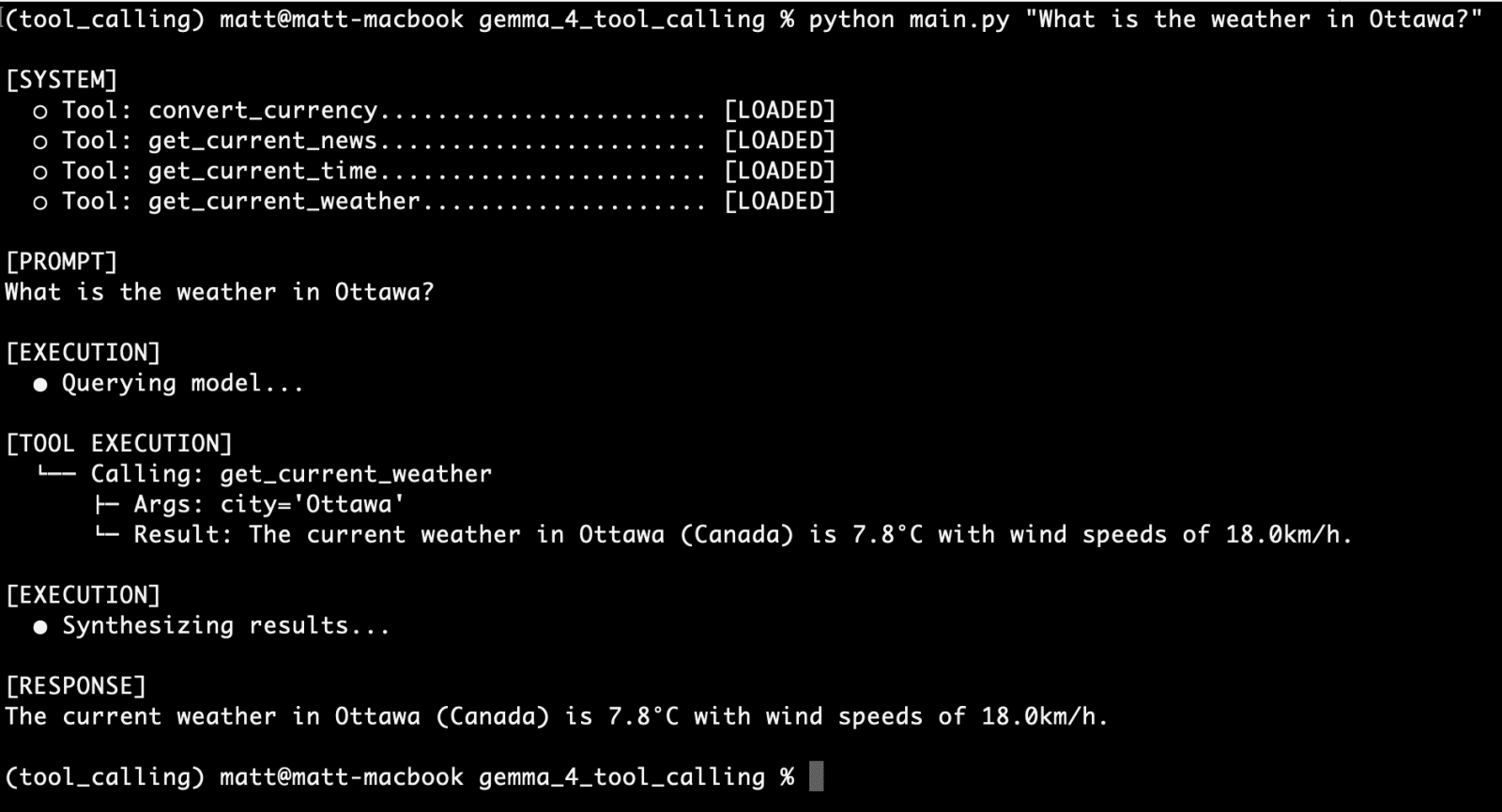
Let’s begin with the primary perform we created, get_current_weather, with the next question:
What’s the climate in Ottawa?
What’s the climate in Ottawa?
You possibly can see our CLI UI supplies us with:
- affirmation of the obtainable instruments
- the consumer immediate
- particulars on software execution, together with the perform used, the arguments despatched, and the response
- the the language mannequin’s response
It seems as if we now have a profitable first run.
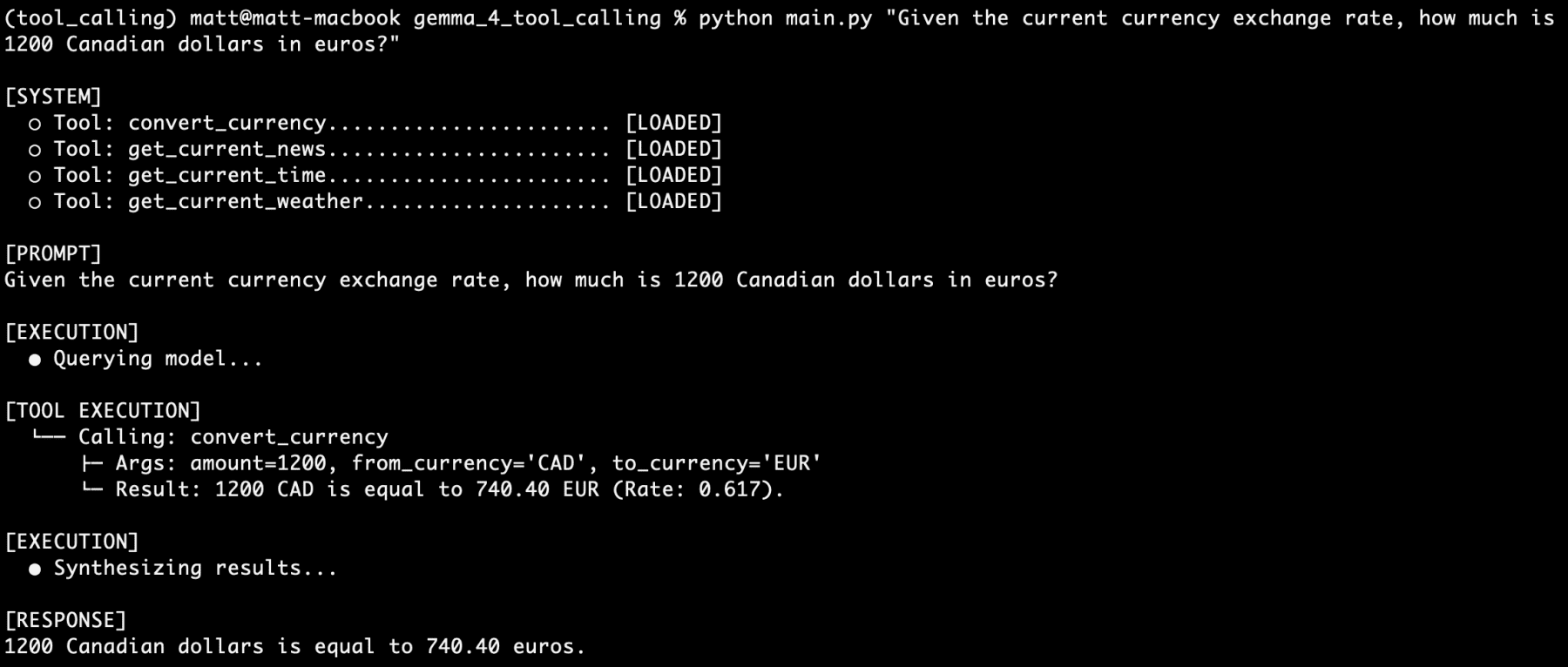
Subsequent, let’s check out one other of our instruments independently, particularly convert_currency:
Given the present forex trade price, how a lot is 1200 Canadian {dollars} in euros?
Given the present forex trade price, how a lot is 1200 Canadian {dollars} in euros?
Extra successful.
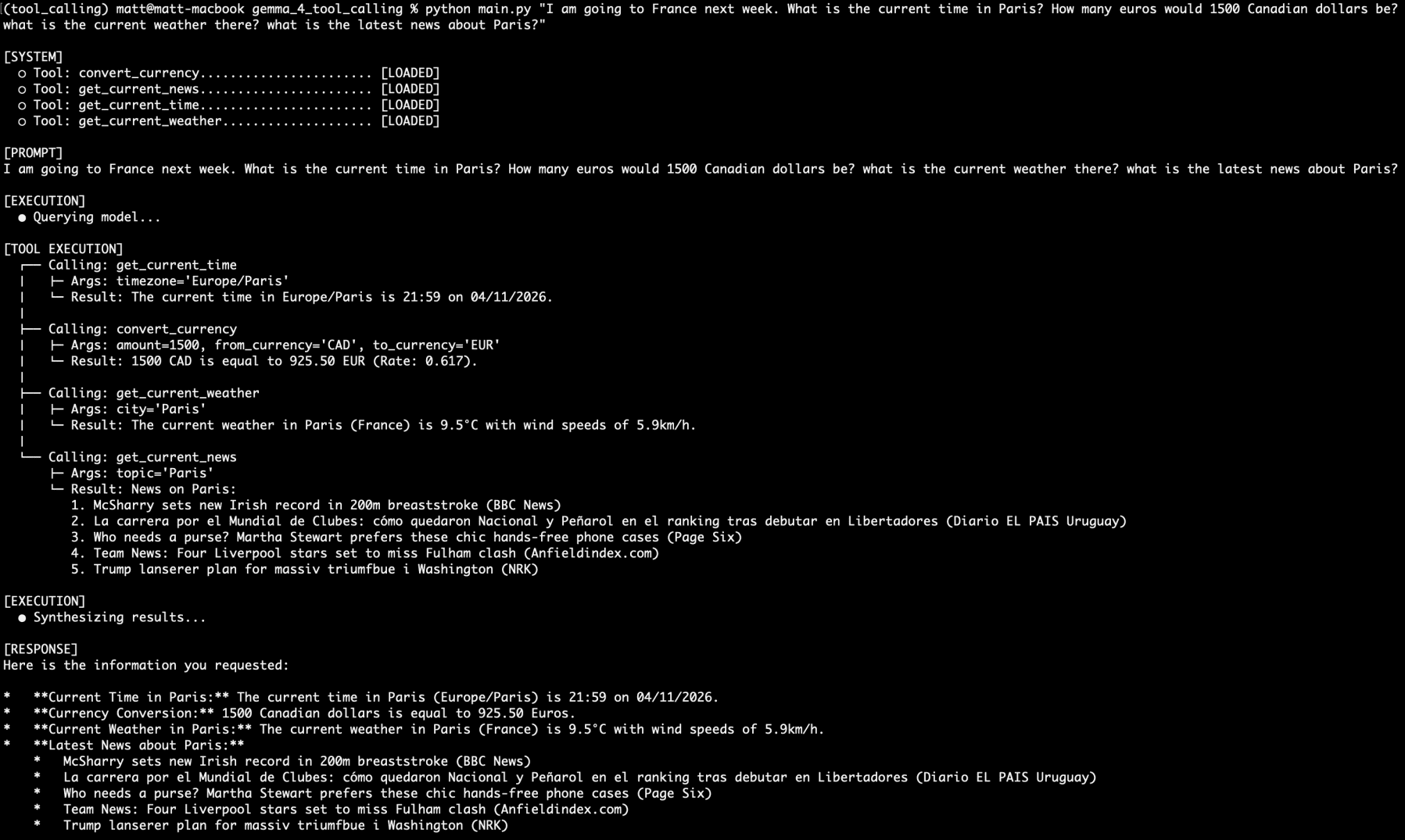
Now, let’s stack software calling requests. Let’s additionally take into account that we’re utilizing a 4 billion parameter mannequin that has half of its parameters lively at anyone time throughout inference:
I’m going to France subsequent week. What’s the present time in Paris? What number of euros would 1500 Canadian {dollars} be? what’s the present climate there? what’s the newest information about Paris?
I’m going to France subsequent week…
Would you have a look at that. All 4 questions answered by 4 totally different capabilities from the 4 separate software calls. All on an area, personal, extremely small language mannequin served by Ollama.
I ran queries on this setup over the course of the weekend, and by no means as soon as did the mannequin’s reasoning fail. By no means as soon as. A whole bunch of prompts. Admittedly, they have been on the identical 4 instruments, however no matter how obscure my in any other case affordable wording change into, I couldn’t stump it.
Gemma 4 definitely seems to be a powerhouse of a small language mannequin reasoning engine with software calling capabilities. I’ll be turning my consideration to constructing out a completely agentic system subsequent, so keep tuned.
Conclusion
The arrival of software calling habits inside open-weight fashions is likely one of the extra helpful and sensible developments in native AI of late. With the discharge of Gemma 4, we will function securely offline, constructing advanced methods unfettered by cloud and API restrictions. By architecturally integrating direct entry to the online, native file methods, uncooked knowledge processing logic, and localized APIs, even low-powered client units can function autonomously in ways in which have been beforehand restricted completely to cloud-tier {hardware}.
🔥 Need the perfect instruments for AI advertising? Take a look at GetResponse AI-powered automation to spice up your enterprise!

