

🚀 Able to supercharge your AI workflow? Strive ElevenLabs for AI voice and speech era!
On this article, you’ll study sensible, protected methods to make use of knowledge augmentation to cut back overfitting and enhance generalization throughout photos, textual content, audio, and tabular datasets.
Subjects we are going to cowl embrace:
- How augmentation works and when it helps.
- On-line vs. offline augmentation methods.
- Arms-on examples for photos (TensorFlow/Keras), textual content (NLTK), audio (librosa), and tabular knowledge (NumPy/Pandas), plus the important pitfalls of knowledge leakage.
Alright, let’s get to it.
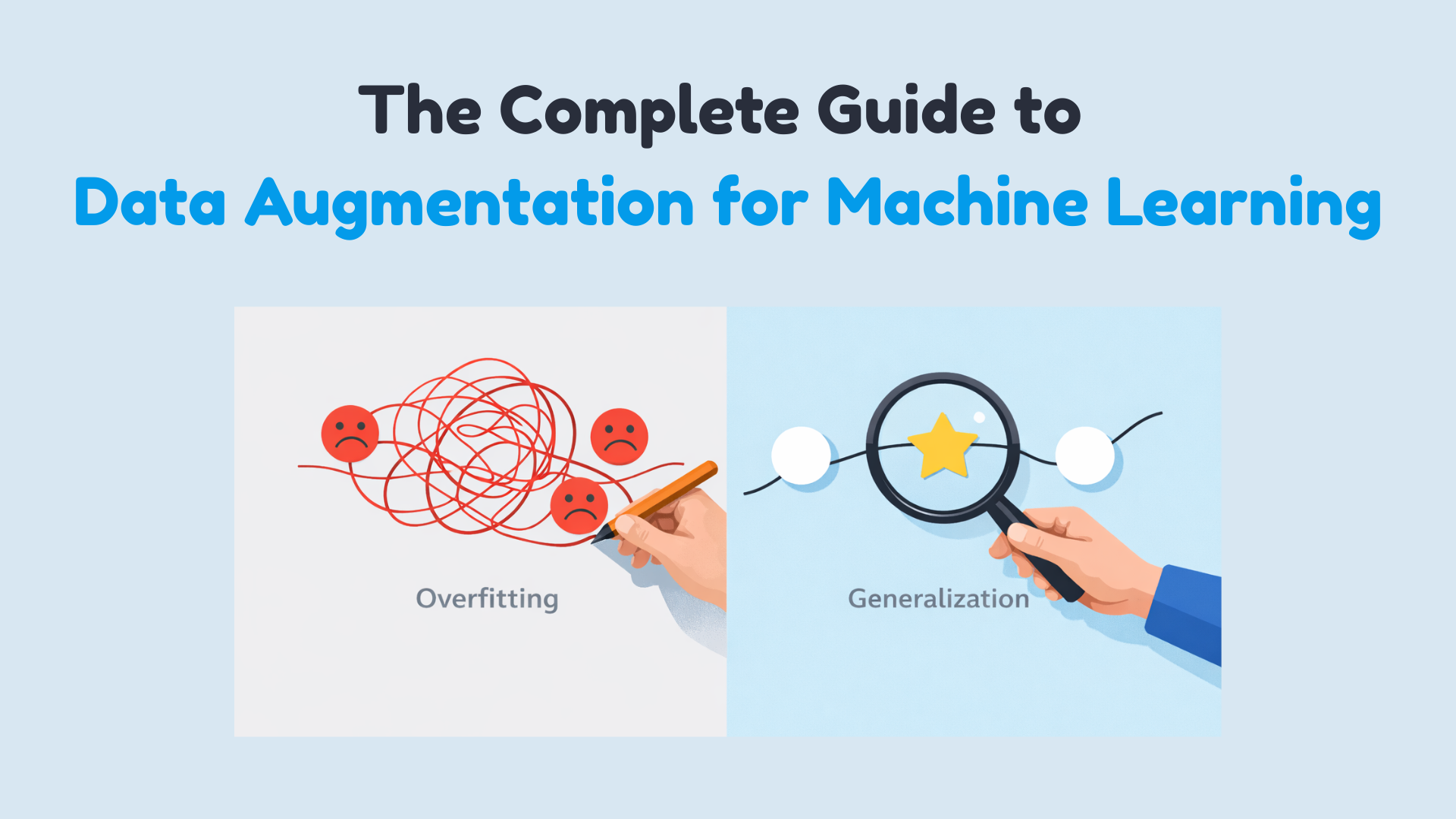
The Full Information to Information Augmentation for Machine Studying
Picture by Creator
Suppose you’ve constructed your machine studying mannequin, run the experiments, and stared on the outcomes questioning what went unsuitable. Coaching accuracy seems to be nice, perhaps even spectacular, however once you examine validation accuracy… not a lot. You possibly can remedy this situation by getting extra knowledge. However that’s sluggish, costly, and generally simply inconceivable.
It’s not about inventing pretend knowledge. It’s about creating new coaching examples by subtly modifying the information you have already got with out altering its that means or label. You’re displaying your mannequin the identical idea in a number of kinds. You might be instructing what’s vital and what could be ignored. Augmentation helps your mannequin generalize as an alternative of merely memorizing the coaching set. On this article, you’ll learn the way knowledge augmentation works in observe and when to make use of it. Particularly, we’ll cowl:
- What knowledge augmentation is and why it helps cut back overfitting
- The distinction between offline and on-line knowledge augmentation
- Learn how to apply augmentation to picture knowledge with TensorFlow
- Easy and protected augmentation strategies for textual content knowledge
- Frequent augmentation strategies for audio and tabular datasets
- Why knowledge leakage throughout augmentation can silently break your mannequin
Offline vs On-line Information Augmentation
Augmentation can occur earlier than coaching or throughout coaching. Offline augmentation expands the dataset as soon as and saves it. On-line augmentation generates new variations each epoch. Deep studying pipelines normally choose on-line augmentation as a result of it exposes the mannequin to successfully unbounded variation with out rising storage.
Information Augmentation for Picture Information
Picture knowledge augmentation is essentially the most intuitive place to begin. A canine continues to be a canine if it’s barely rotated, zoomed, or considered below completely different lighting circumstances. Your mannequin must see these variations throughout coaching. Some widespread picture augmentation strategies are:
- Rotation
- Flipping
- Resizing
- Cropping
- Zooming
- Shifting
- Shearing
- Brightness and distinction modifications
These transformations don’t change the label—solely the looks. Let’s display with a easy instance utilizing TensorFlow and Keras:
1. Importing Libraries
|
import tensorflow as tf from tensorflow.keras.datasets import mnist from tensorflow.keras.layers import Dense, Flatten, Conv2D, MaxPooling2D, Dropout from tensorflow.keras.utils import to_categorical from tensorflow.keras.preprocessing.picture import ImageDataGenerator from tensorflow.keras.fashions import Sequential |
2. Loading MNIST dataset
|
(X_train, y_train), (X_test, y_test) = mnist.load_data()
# Normalize pixel values X_train = X_train / 255.0 X_test = X_test / 255.0
# Reshape to (samples, peak, width, channels) X_train = X_train.reshape(–1, 28, 28, 1) X_test = X_test.reshape(–1, 28, 28, 1)
# One-hot encode labels y_train = to_categorical(y_train, 10) y_test = to_categorical(y_test, 10) |
Output:
|
Downloading knowledge from https://storage.googleapis.com/tensorflow/tf-keras-datasets/mnist.npz |
3. Defining ImageDataGenerator for augmentation
|
datagen = ImageDataGenerator( rotation_range=15, # rotate photos by ±15 levels width_shift_range=0.1, # 10% horizontal shift height_shift_range=0.1, # 10% vertical shift zoom_range=0.1, # zoom in/out by 10% shear_range=0.1, # apply shear transformation horizontal_flip=False, # not wanted for digits fill_mode=‘nearest’ # fill lacking pixels after transformations ) |
4. Constructing a Easy CNN Mannequin
|
mannequin = Sequential([ Conv2D(32, (3, 3), activation=‘relu’, input_shape=(28, 28, 1)), MaxPooling2D((2, 2)), Conv2D(64, (3, 3), activation=‘relu’), MaxPooling2D((2, 2)), Flatten(), Dropout(0.3), Dense(64, activation=‘relu’), Dense(10, activation=‘softmax’) ])
mannequin.compile(optimizer=‘adam’, loss=‘categorical_crossentropy’, metrics=[‘accuracy’]) |
5. Coaching the mannequin
|
batch_size = 64 epochs = 5
historical past = mannequin.match( datagen.move(X_train, y_train, batch_size=batch_size, shuffle=True), steps_per_epoch=len(X_train)//batch_size, epochs=epochs, validation_data=(X_test, y_test) ) |
Output:

6. Visualizing Augmented Pictures
|
import matplotlib.pyplot as plt
# Visualize 5 augmented variants of the primary coaching pattern plt.determine(figsize=(10, 2)) for i, batch in enumerate(datagen.move(X_train[:1], batch_size=1)): plt.subplot(1, 5, i + 1) plt.imshow(batch[0].reshape(28, 28), cmap=‘grey’) plt.axis(‘off’) if i == 4: break plt.present() |
Output:

Information Augmentation for Textual Information
Textual content is extra delicate. You possibly can’t randomly substitute phrases with out excited about that means. However small, managed modifications can assist your mannequin generalize. A easy instance utilizing synonym alternative (with NLTK):
|
1 2 3 4 5 6 7 8 9 10 11 12 13 14 15 16 17 18 19 20 |
import nltk from nltk.corpus import wordnet import random
nltk.obtain(“wordnet”) nltk.obtain(“omw-1.4”)
def synonym_replacement(sentence): phrases = sentence.break up() if not phrases: return sentence idx = random.randint(0, len(phrases) – 1) synsets = wordnet.synsets(phrases[idx]) if synsets and synsets[0].lemmas(): alternative = synsets[0].lemmas()[0].identify().substitute(“_”, ” “) phrases[idx] = alternative return ” “.be part of(phrases)
textual content = “The film was actually good” print(synonym_replacement(textual content)) |
Output:
|
[nltk_data] Downloading bundle wordnet to /root/nltk_data... The film was really good |
Identical that means. New coaching instance. In observe, libraries like nlpaug or back-translation APIs are sometimes used for extra dependable outcomes.
Information Augmentation for Audio Information
Audio knowledge additionally advantages closely from augmentation. Some widespread audio augmentation strategies are:
- Including background noise
- Time stretching
- Pitch shifting
- Quantity scaling
One of many easiest and mostly used audio augmentations is including background noise and time stretching. These assist speech and sound fashions carry out higher in noisy, real-world environments. Let’s perceive with a easy instance (utilizing librosa):
|
1 2 3 4 5 6 7 8 9 10 11 12 13 14 15 16 17 18 |
import librosa import numpy as np
# Load built-in trumpet audio from librosa audio_path = librosa.ex(“trumpet”) audio, sr = librosa.load(audio_path, sr=None)
# Add background noise noise = np.random.randn(len(audio)) audio_noisy = audio + 0.005 * noise
# Time stretching audio_stretched = librosa.results.time_stretch(audio, price=1.1)
print(“Pattern price:”, sr) print(“Authentic size:”, len(audio)) print(“Noisy size:”, len(audio_noisy)) print(“Stretched size:”, len(audio_stretched)) |
Output:
|
Downloading file ‘sorohanro_-_solo-trumpet-06.ogg’ from ‘https://librosa.org/knowledge/audio/sorohanro_-_solo-trumpet-06.ogg’ to ‘/root/.cache/librosa’. Pattern price: 22050 Authentic size: 117601 Noisy size: 117601 Stretched size: 106910 |
It is best to observe that the audio is loaded at 22,050 Hz. Now, including noise doesn’t change its size, so the noisy audio is identical measurement as the unique. Time stretching hastens the audio whereas preserving content material.
Information Augmentation for Tabular Information
Tabular knowledge is essentially the most delicate knowledge kind to enhance. Not like photos or audio, you can’t arbitrarily modify values with out breaking the information’s logical construction. Nevertheless, some widespread augmentation strategies exist:
- Noise Injection: Add small, random noise to numerical options whereas preserving the general distribution.
- SMOTE: Generates artificial samples for minority courses in classification issues.
- Mixing: Mix rows or columns in a method that maintains label consistency.
- Area-Particular Transformations: Apply logic-based modifications relying on the dataset (e.g., changing currencies, rounding, or normalizing).
- Characteristic Perturbation: Barely alter enter options (e.g., age ± 1 yr, earnings ± 2%).
Now, let’s perceive with a easy instance utilizing noise injection for numerical options (by way of NumPy and Pandas):
|
1 2 3 4 5 6 7 8 9 10 11 12 13 14 15 16 17 18 19 20 21 |
import numpy as np import pandas as pd
# Pattern tabular dataset knowledge = { “age”: [25, 30, 35, 40], “earnings”: [40000, 50000, 60000, 70000], “credit_score”: [650, 700, 750, 800] }
df = pd.DataFrame(knowledge)
# Add small Gaussian noise to numerical columns augmented_df = df.copy() noise_factor = 0.02 # 2% noise
for col in augmented_df.columns: noise = np.random.regular(0, noise_factor, measurement=len(df)) augmented_df[col] = augmented_df[col] * (1 + noise)
print(augmented_df) |
Output:
|
age earnings credit score_rating 0 24.399643 41773.983250 651.212014 1 30.343270 50962.007818 696.959347 2 34.363792 58868.638800 757.656837 3 39.147648 69852.508717 780.459666 |
You possibly can see that this barely modifies the numerical values however preserves the general knowledge distribution. It additionally helps the mannequin generalize as an alternative of memorizing actual values.
The Hidden Hazard of Information Leakage
This half is non-negotiable. Information augmentation have to be utilized solely to the coaching set. It is best to by no means increase validation or take a look at knowledge. If augmented knowledge leaks into the analysis, your metrics change into deceptive. Your mannequin will look nice on paper and fail in manufacturing. Clear separation just isn’t a greatest observe; it’s a requirement.
Conclusion
Information augmentation helps when your knowledge is proscribed, overfitting is current, and real-world variation exists. It doesn’t repair incorrect labels, biased knowledge, or poorly outlined options. That’s why understanding your knowledge at all times comes earlier than making use of transformations. It isn’t only a trick for competitions or deep studying demos. It’s a mindset shift. You don’t must chase extra knowledge, however you need to begin asking how your current knowledge may naturally change. Your fashions cease overfitting, begin generalizing, and at last behave the best way you anticipated them to within the first place.
🔥 Need the most effective instruments for AI advertising and marketing? Try GetResponse AI-powered automation to spice up your small business!

