

🚀 Able to supercharge your AI workflow? Attempt ElevenLabs for AI voice and speech era!
On this article, you’ll study when fine-tuning giant language fashions is warranted, which 2025-ready strategies and instruments to decide on, and the best way to keep away from the commonest errors that derail tasks.
Matters we’ll cowl embody:
- A sensible determination framework: immediate engineering, retrieval-augmented era (RAG), and when fine-tuning really provides worth.
- Immediately’s important strategies—LoRA/QLoRA, Spectrum—and alignment with DPO, plus when to choose every.
- Information preparation, analysis, and confirmed configurations that maintain you out of hassle.
Let’s not waste any extra time.
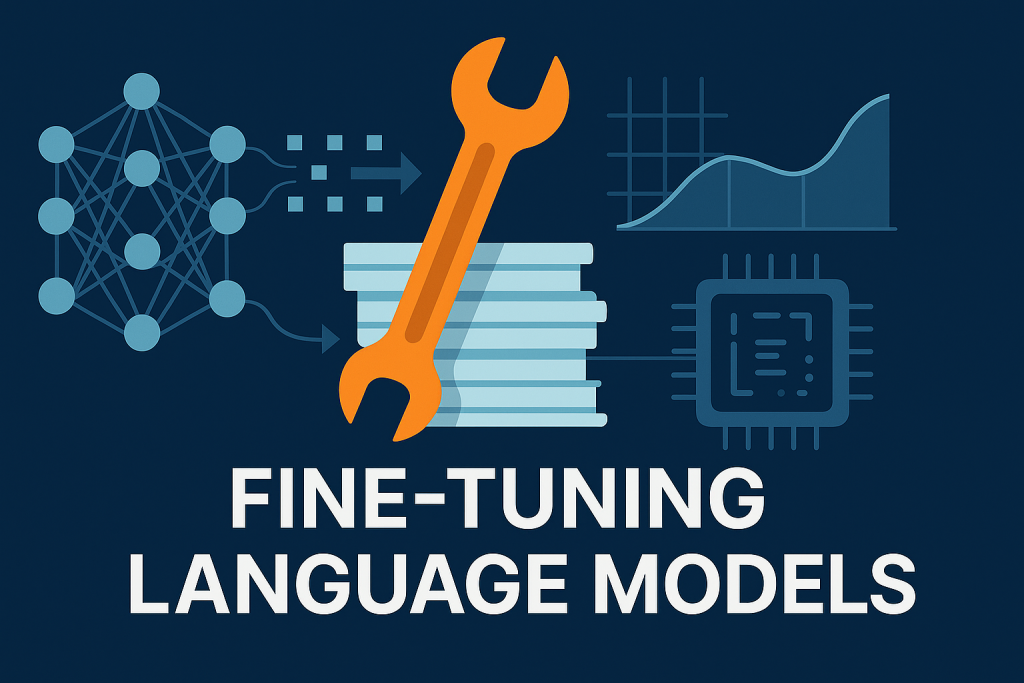
The Machine Studying Practitioner’s Information to High-quality-Tuning Language Fashions
Picture by Writer
Introduction
High-quality-tuning has grow to be way more accessible in 2024–2025, with parameter-efficient strategies letting even 70B+ parameter fashions run on shopper GPUs. However do you have to fine-tune in any respect? And in that case, how do you select between the handfuls of rising methods?
This information is for practitioners who need outcomes, not simply concept. You’ll study when fine-tuning is sensible, which strategies to make use of, and the best way to keep away from widespread pitfalls.
High-quality-tuning is totally different from conventional machine studying. As an alternative of coaching fashions from scratch, you’re adapting pretrained fashions to specialised duties utilizing far much less knowledge and compute. This makes refined pure language processing (NLP) capabilities accessible with out billion-dollar budgets.
For machine studying practitioners, this builds on abilities you have already got. Information preparation, analysis frameworks, and hyperparameter tuning stay central. You’ll have to study new architectural patterns and effectivity methods, however your current basis offers you a significant benefit.
You’ll study:
- When fine-tuning gives worth versus easier options like immediate engineering or retrieval-augmented era (RAG)
- The core parameter-efficient strategies (LoRA, QLoRA, Spectrum) and when to make use of every
- Trendy alignment methods (DPO, RLHF) that make fashions observe directions reliably
- Information preparation methods that decide most of your fine-tuning success
- Essential pitfalls in overfitting and catastrophic forgetting, and the best way to keep away from them
If you happen to’re already working with LLMs, you could have what you want. If you happen to want a refresher, try our guides on immediate engineering and LLM purposes.
Earlier than moving into fine-tuning mechanics, you want to perceive whether or not fine-tuning is the fitting method.
When to High-quality-Tune Versus Various Approaches
High-quality-tuning needs to be your final resort, not your first alternative. The beneficial development begins with immediate engineering, escalates to RAG when exterior data is required, and solely proceeds to fine-tuning when deep specialization is required.
Google Cloud’s determination framework and Meta AI’s sensible information establish clear standards: Use immediate engineering for primary process adaptation. Use RAG once you want supply citations, should floor responses in paperwork, or data modifications regularly. Meta AI reveals 5 situations the place fine-tuning gives real worth: customizing tone and elegance for particular audiences, sustaining knowledge privateness for delicate data, supporting low-resource languages, lowering inference prices by distilling bigger fashions, and including fully new capabilities not current in base fashions.
The info availability check: With fewer than 100 examples, follow immediate engineering. With 100–1,000 examples and static data, take into account parameter-efficient strategies. Solely with 1,000–100,000 examples and a transparent process definition do you have to try fine-tuning.
For information summarization or common query answering, RAG excels. For buyer assist requiring a particular model voice or code era following specific patterns, fine-tuning proves important. The optimum answer usually combines each—fine-tune for specialised reasoning patterns whereas utilizing RAG for present data.
Important Parameter-Environment friendly High-quality-Tuning Strategies
Full fine-tuning updates all mannequin parameters, requiring huge compute and reminiscence. Parameter-efficient fine-tuning (PEFT) revolutionized this by enabling coaching with simply ~0.1% to three% of parameters up to date, attaining comparable efficiency whereas dramatically lowering necessities.
LoRA (Low-Rank Adaptation) emerged because the dominant method. LoRA freezes pretrained weights and injects trainable rank-decomposition matrices in parallel. As an alternative of updating whole weight matrices, LoRA represents updates as low-rank decompositions. Weight updates throughout adaptation usually have low intrinsic rank, with rank 8 sometimes adequate for a lot of duties.
Reminiscence reductions attain 2× to three× versus full fine-tuning, with checkpoint sizes lowering 1,000× to 10,000×. A 350 GB mannequin can require solely a ~35 MB adapter file. Coaching could be ~25% sooner on giant fashions. Critically, discovered matrices merge with frozen weights throughout deployment, introducing zero inference latency.
QLoRA extends LoRA by way of aggressive quantization whereas sustaining accuracy. Base weights are saved in 4-bit format with computation occurring in 16-bit bfloat16. The outcomes could be dramatic: 65B fashions on 48 GB GPUs, 33B on 24 GB, 13B on shopper 16 GB {hardware}—whereas matching many 16-bit full fine-tuning outcomes.
Spectrum, a 2024 innovation, takes a distinct method. Slightly than including adapters, Spectrum identifies probably the most informative layers utilizing signal-to-noise ratio evaluation and selectively fine-tunes solely the highest ~30%. Studies present greater accuracy than QLoRA on mathematical reasoning with comparable assets.
Determination framework: Use LoRA once you want zero inference latency and average GPU assets (16–24 GB). Use QLoRA for excessive reminiscence constraints (shopper GPUs, Google Colab) or very giant fashions (30B+). Use Spectrum when working with giant fashions in distributed settings.
Able to implement LoRA and QLoRA? Learn how to fine-tune open LLMs in 2025 by Phil Schmid gives full code examples with present finest practices. For hands-on apply, strive Unsloth’s free Colab notebooks.
Trendy Alignment and Instruction Tuning
Instruction tuning transforms completion-focused base fashions into instruction-following assistants, establishing primary capabilities earlier than alignment. The tactic trains on numerous instruction-response pairs protecting query answering, summarization, translation, and reasoning. High quality issues excess of amount, with ~1,000 high-quality examples usually adequate.
Direct Choice Optimization (DPO) has quickly grow to be the popular alignment technique by dramatically simplifying reinforcement studying from human suggestions (RLHF). The important thing concept: re-parameterize the reward as implicit within the coverage itself, fixing the RLHF goal by way of supervised studying fairly than complicated reinforcement studying.
Analysis from Stanford and others stories that DPO can obtain comparable or superior efficiency to PPO-based RLHF with single-stage coaching, ~50% much less compute, and larger stability. DPO requires solely choice knowledge (immediate, chosen response, rejected response), a reference coverage, and normal supervised studying infrastructure. The tactic has grow to be widespread for coaching open-source LLMs in 2024–2025, together with Zephyr-7B and varied Mistral-based fashions.
RLHF stays the foundational alignment method however brings excessive complexity: managing 4 mannequin copies throughout coaching (coverage, reference, reward, worth), tough implementations, and coaching instability. OpenAI’s InstructGPT demonstrated {that a} 1.3B aligned mannequin might outperform a 175B base mannequin on human evaluations, underscoring alignment’s energy. Nevertheless, most practitioners ought to use DPO except particular situations demand RLHF’s flexibility.
Begin with instruction tuning utilizing datasets like Alpaca or Dolly-15k, then implement DPO for alignment fairly than trying RLHF. TRL (Transformer Reinforcement Studying) documentation gives complete guides for each DPO and RLHF with working code examples. For conceptual understanding, see Chip Huyen’s RLHF: Reinforcement Studying from Human Suggestions.
Information Preparation Finest Practices
Information high quality determines fine-tuning success greater than another issue. As error charges in coaching knowledge enhance linearly, downstream mannequin error can rise superlinearly—making knowledge curation your highest-leverage exercise.
Dataset dimension necessities differ by process complexity. Easy classification wants ~200 to 1,000 examples. Medium-complexity duties like query answering require ~1,000 to five,000. Complicated era or reasoning can demand 5,000 to 10,000+. High quality trumps amount: 1,000 high-quality examples can outperform 100,000 mediocre ones.
Excessive-quality knowledge displays 5 traits: area relevance, range throughout situations, representativeness of the complete distribution, labeling accuracy, and freshness for time-sensitive domains.
Formatting impacts outcomes considerably. Use structured question-answer pairs with constant formatting throughout datasets to forestall spurious sample studying. Commonplace splits allocate ~80% coaching and ~20% validation utilizing stratified sampling when relevant.
Important preprocessing: clear noise, deal with lacking values, use model-specific tokenizers, take away duplicates, and normalize textual content. Favor proprietary customized knowledge over public datasets that fashions could have already encountered throughout pretraining.
Need assistance with knowledge preparation? Meta AI’s information Learn how to fine-tune: Deal with efficient datasets emphasizes proprietary knowledge methods and gives sensible curation methods. For dataset exploration, browse Hugging Face Datasets to see high quality examples.
Avoiding Essential Pitfalls
Overfitting happens when fashions memorize coaching knowledge as a substitute of studying generalizable patterns. It’s the commonest fine-tuning failure. Indicators embody coaching loss lowering whereas validation loss will increase, excessive coaching accuracy however poor validation efficiency, and loss approaching zero.
Prevention requires a number of methods. Early stopping halts coaching when validation efficiency plateaus. Regularization consists of L2 weight decay, 10%–30% dropout, and weight penalties. Information augmentation will increase range by way of back-translation and artificial era. Ok-fold cross-validation helps guarantee generalization throughout splits.
For parameter-efficient fine-tuning (PEFT) strategies, scale back LoRA rank (r parameter) and alpha values to lower trainable parameters. Use studying charges of 1e-4 to 2e-4 for fine-tuning. Monitor each coaching and validation losses constantly. PEFT strategies like LoRA naturally scale back overfitting by limiting trainable parameters to ~0.1%–1%.
Catastrophic forgetting poses a extra insidious problem: lack of beforehand discovered data when coaching on new duties. Fashions can lose common reasoning skills, decline on beforehand answerable questions, and overfit to particular output codecs. Forgetting can start early in fine-tuning by way of format specialization.
Prevention methods embody elastic weight consolidation (EWC), which identifies and protects essential weights; “half fine-tuning,” which freezes roughly half of parameters throughout every spherical; and sharpness-aware minimization (SAM), which flattens the loss panorama. Most accessible: embody numerous instruction datasets combined with domain-specific knowledge.
Battling overfitting or catastrophic forgetting? The paper Revisiting Catastrophic Forgetting in Giant Language Mannequin Tuning gives sensible mitigation methods with empirical proof. For monitoring and debugging, use Weights & Biases or TensorBoard to trace coaching and validation metrics constantly.
Sensible Instruments and Getting Began
The Hugging Face ecosystem gives the muse for contemporary fine-tuning. The Transformers library affords mannequin entry, PEFT implements parameter-efficient strategies, TRL handles coaching with reinforcement studying and supervised fine-tuning, and bitsandbytes permits quantization.
Unsloth delivers ~2× sooner coaching and as much as ~80% much less reminiscence by way of customized Triton kernels, engaged on single T4 or shopper GPUs. It’s free on Colab and Kaggle. LlamaFactory has emerged as a unified answer, supporting 100+ fashions with configuration-based coaching. For very giant fashions, totally sharded knowledge parallelism (FSDP) mixed with QLoRA permits coaching of 70B fashions on twin shopper GPUs.
The beneficial 2025 stack for ~8B fashions: QLoRA or Spectrum + FlashAttention-2 + Liger Kernels + gradient checkpointing. This allows Llama-3.1-8B coaching in round two hours on a single robust GPU or effectively underneath half an hour distributed throughout 8 GPUs (your mileage will differ).
Really helpful preliminary configuration: Select Llama-3.1-8B or Phi-3-mini as base fashions for good efficiency and manageable dimension. Use QLoRA for 4-bit quantization enabling consumer-GPU coaching. Implement on Unsloth totally free entry. Begin with 512–1,024 token sequences. Set studying price to 2e-4. Use batch dimension 4–8 with gradient accumulation 2–4 steps. Allow gradient checkpointing and sequence packing for effectivity.
Important datasets for apply: Alpaca (52K) for instruction tuning, Dolly-15k for high-quality human examples, OpenAssistant for conversational knowledge, Anthropic HH-RLHF for choice studying.
Able to construct your first fine-tuned mannequin? Begin with Hugging Face’s LLM Course chapter on supervised fine-tuning, which walks by way of the whole course of step-by-step. For manufacturing deployments, discover LlamaFactory, which helps 100+ fashions with easy YAML configuration.
Your Studying Path
For machine studying practitioners new to fine-tuning, undertake a progressive studying method that builds abilities systematically.
Begin with instruction tuning: High-quality-tune base T5 or base Llama-2 on the Alpaca dataset. Deal with understanding instruction-response knowledge formatting and use the Hugging Face TRL SFTTrainer with LoRA for environment friendly coaching. This establishes foundations in knowledge preparation, coaching, and analysis.
Progress to DPO: Practice on small choice datasets like Anthropic HH-RLHF or UltraFeedback. Examine efficiency in opposition to your supervised fine-tuning baseline. Perceive implicit rewards and choice studying. DPO’s simplicity makes it best for studying alignment ideas with out reinforcement studying complexity.
Experiment with manufacturing methods: Begin with small fashions (1B to 3B parameters) to iterate rapidly. Use current implementations fairly than constructing from scratch. Carry out cautious ablations isolating the influence of various selections. Consider rigorously utilizing a number of metrics earlier than scaling to bigger fashions.
Getting began guidelines: Outline a transparent process and success standards, together with goal metrics. Select one to 2 customized analysis metrics and two to a few system-level metrics (most 5 whole). Put together a minimal of ~1,000 examples, prioritizing high quality over amount with an 80/20 practice/validation cut up. Arrange your analysis framework earlier than coaching begins. Begin fine-tuning utilizing PEFT strategies with confirmed hyperparameters. Monitor constantly to forestall pitfalls. With QLoRA enabling 13B fashions on 16 GB GPUs and free platforms like Google Colab with Unsloth optimization, you can begin experimenting right now.
In search of analysis finest practices? The information LLM Analysis Metrics: The Final Information covers G-Eval, task-specific metrics, and LLM-as-a-judge strategies. Implement evaluations utilizing DeepEval for open-source analysis frameworks.
The sphere continues evolving quickly, with 2024–2025 advances bringing important speed-ups (usually 3–5×), improved effectivity methods, and expanded business availability. Begin with small fashions and confirmed methods, then scale as you get snug with the basics.
🔥 Need the perfect instruments for AI advertising and marketing? Take a look at GetResponse AI-powered automation to spice up your online business!
