

🚀 Automate your workflows with AI instruments! Uncover GetResponse AI-powered automation and save time!
Most agentic AI methods begin within the improper place. They begin with brokers: find out how to construct them, the place to deploy them, how briskly they’ll take over work. That intuition is comprehensible as a result of the know-how carries real transformative potential, and the enterprise strain to behave on it’s actual. Nevertheless it skips the more durable query: what your enterprise is definitely able to help. And it overlooks what enterprises have already got a long time of encoded course of intelligence that brokers have to be price something in manufacturing.
We’ve been right here earlier than. When cloud arrived, the early playbook was lift-and-shift. The organizations that got here out forward paused and requested one thing completely different first: “How do our methods want to vary to work on this new mannequin?”
Agentic AI calls for the identical reframe, and the stakes are larger. Enterprises need to transfer quick on AI. What they don’t need is to search out out later that pace got here at the price of management over the processes the enterprise runs on. Getting each requires greater than deploying brokers.
Cloud gave you a decade to adapt, however agentic AI calls for management from day 1
Asserting an agentic AI technique and being prepared for one are two very various things.
With cloud, most enterprises had years to determine it out. There was room to look at early adopters, study from their errors and nonetheless shut the hole. Agentic AI is unfolding in a different way and at a tempo that makes the previous timeline irrelevant. SAP alone has introduced greater than 200 brokers and assistants spanning finance, procurement, provide chain, HCM and buyer expertise, all in a single product cycle. The window for “wait and see” is compressing in actual time.
The market is progressing from co-pilots aiding particular person customers to brokers executing discrete duties to multi-agent methods working throughout end-to-end enterprise processes. Most enterprises are someplace within the first two phases proper now, operating pilots, testing the place brokers might be trusted and understanding how they match into broader workflows.
However the coordination challenges that come subsequent are already seen. As brokers begin touching the identical methods and processes, questions on governance, dependency administration and accountability don’t keep theoretical for lengthy.
Who owns the end result when brokers are working throughout the identical methods concurrently?
What occurs when one agent’s motion invalidates one other’s mid-workflow?
Most present methods don’t have good solutions to these questions but, as a result of the main focus has been on getting brokers deployed moderately than on what governs them as soon as they’re.
The trail to agentic AI runs by orchestration, not round it.
The true bottleneck? Execution, not intelligence
Each enterprise course of an agent touches was constructed earlier than brokers existed, so it was designed for deterministic logic, human oversight and predictable inputs. Layering intelligence on high of that infrastructure provides a brand new supply of complexity that the underlying methods don’t have any approach to soak up.
Brokers can resolve what to do. That half is getting simpler each month. What they’ll’t do reliably is function contained in the constraints these methods had been constructed round.
Ask an AI assistant to assist shut the books at month-end. It could possibly summarize standing and flag anomalies, however the second it must set off the intercompany elimination run, test whether or not the prior step accomplished efficiently, wait on a dependency from a separate system after which kick off consolidation in the proper sequence, it hits a wall. The enterprise logic that governs how that course of runs lives inside your enterprise methods, and it wasn’t written down final yr. It was encoded over years of implementation, audit cycles and arduous classes. The agent has no dependable approach to function inside it, and no approach to reconstruct it by itself.
The identical is true within the provide chain. An agent can analyze demand alerts and suggest a replenishment order, however executing that advice means touching stock methods, ERP planning runs, provider APIs and warehouse administration in a particular sequence, with particular dependencies and beneath particular enterprise guidelines. One step out of order, and also you’re taking a look at a damaged course of.
Enterprises run on deterministic, interconnected workflows constructed for consistency, compliance and predictability. AI fashions are probabilistic. They discover, purpose and adapt, which is strictly what makes them helpful. However as a result of enterprise workflows comply with outlined paths, bringing these two worlds collectively requires greater than giving brokers entry to your methods.
A mannequin that may see your workflows isn’t the identical as one that may reliably execute them. With no managed execution layer between the agent and the method, you find yourself with one thing that appears succesful in a demo and falls aside in manufacturing.
What about legacy methods you don’t need to refactor?
For enterprises with mature ERP environments, legacy middleware or on-premises methods constructed over a long time, the calculus is evident: you aren’t going to refactor SAP ECC, Oracle EBS or a 20-year-old mainframe course of to “turn into agent-ready.” Nor must you.
That is the place a protocol-based strategy adjustments the equation. A well-designed MCP implementation permits these methods to floor what they know and what they’ll do to AI brokers, with out touching the underlying code. The agent doesn’t must know that it’s speaking to a legacy system; it simply wants a constant interface. The hard-won course of logic, the enterprise guidelines, the compliance controls, all of it stays in place. What adjustments is that brokers can now attain it.
Take into account what meaning. The method logic inside a mature SAP ECC surroundings or a mainframe-based provide chain isn’t simply code. It’s 20 or 30 years of enterprise selections, regulatory responses, exception dealing with and operational studying made concrete. That’s not a legal responsibility to modernize away. It’s institutional capital. A protocol-based structure treats it that method: as one thing to show and lengthen, not exchange.
This is among the most underappreciated benefits of a protocol-based structure for enterprise AI. It doesn’t require you to modernize every thing earlier than you can begin. It allows you to lengthen agentic functionality to the methods you already depend on, at no matter tempo your group can soak up.
Multi-agent methods want greater than entry
The second a number of AI brokers begin interacting with enterprise methods and not using a management aircraft, the questions turn into very sensible, in a short time:
- Who orchestrates execution throughout agentic workflows?
- How are dependencies enforced?
- What occurs when two brokers act on the identical course of concurrently?
- How do you reconstruct an audit path when selections had been made at machine pace throughout a number of methods?
The solutions don’t come from the brokers themselves. An agent optimizing a procurement workflow doesn’t know (and shouldn’t be anticipated to know) that one other agent simply put a maintain on the identical provider for a compliance purpose. With out orchestration, each actions proceed, and the affect is tough to untangle.
The identical power that makes agentic AI highly effective — its skill to behave rapidly throughout methods — additionally makes it a brand new type of legal responsibility when left ungoverned. Orchestration debt begins with the second agent you deploy. Most groups don’t really feel it till the tenth, by which level the untangling is significantly dearer than constructing the management layer upfront.
MCP is the proper protocol — and the improper place to cease
Mannequin Context Protocol (MCP) solves an actual and longstanding downside: how AI methods connect with enterprise instruments and purposes. Since Anthropic launched it as an open customary in late 2024, adoption has been putting, with each main AI vendor now on board, greater than 10,000 energetic public MCP servers and the protocol donated to the Linux Basis’s Agentic AI Basis to make sure it stays open and community-driven.
The breadth of enterprise funding reinforces why MCP issues. SAP has constructed MCP server help straight into its ABAP growth surroundings, opening its core ERP ecosystem to the total agentic AI ecosystem. AWS has embedded MCP because the connectivity customary inside Amazon Bedrock AgentCore, its manufacturing platform for enterprise agent deployment. These aren’t experiments. They’re architectural commitments from the biggest enterprise software program distributors on the planet.
However understanding what MCP is and what it intentionally isn’t is vital for enterprise architects.
MCP is a connectivity protocol. It standardizes how brokers uncover and name instruments, learn knowledge from methods and obtain context. That scope is intentional. MCP was designed to resolve the mixing layer: the “M × N downside” of each AI mannequin needing bespoke connectors to each enterprise system. It solves that elegantly.
What MCP doesn’t do — and doesn’t attempt to do — is orchestrate execution, handle dependencies, implement sequencing or present the governance layer that enterprise processes require. It offers brokers a door into your methods, however it doesn’t management what occurs as soon as they stroll by it.
It’s price noting {that a} second protocol layer, Agent to Agent (A2A), is rising to deal with how brokers coordinate with one another. The place MCP governs what an agent can attain, equivalent to instruments, knowledge and methods, A2A governs who an agent can name on: different specialised brokers, orchestrator brokers managing broader workflows or totally exterior agent companies working outdoors your individual surroundings. Meaning an agent dealing with a procurement exception can delegate to a compliance agent, escalate to a human-in-the-loop workflow or hand off to a third-party agent service, all by a standardized handshake moderately than bespoke integrations.
SAP has drawn this distinction clearly in its AI Agent Hub: if an agent wants a useful resource, it makes use of MCP; if it wants one other agent, it makes use of A2A. That separation is deliberate and vital. Collectively, the 2 protocols create an agnostic and extensible material for enterprise agentic AI that doesn’t lock you right into a single vendor’s orchestration mannequin and accelerates how rapidly new brokers and capabilities might be added. Neither protocol was designed to manipulate what occurs on the course of execution layer beneath, although. With out that layer, connecting brokers to your enterprise merely accelerates fragmentation: extra actions, throughout extra methods, with much less management. That hole stays architectural, and it’s the place enterprise implementations succeed or fail. The implications of A2A for enterprise orchestration deserve an extended dialog.
The market is arriving at this conclusion concurrently
The ambition at SAP Sapphire 2026 was clear. SAP CEO Christian Klein launched the SAP Enterprise AI Platform with a imaginative and prescient of the “Autonomous Enterprise, the place brokers run the enterprise.” The platform encompasses agent growth, agent governance and a reworked software portfolio constructed to make that imaginative and prescient actual.
What Klein additionally acknowledged is the prerequisite that makes it attainable: “No AI agent can compensate for a nasty knowledge panorama.” SAP’s personal evaluation is that brokers fail when enterprise knowledge is fragmented, inconsistent or trapped in disconnected methods. The bold 200-agent roadmap and the operational problem are the identical downside said two other ways.
It is a validation of the underlying structure query. The distributors who’re most severe about agentic AI are those most clearly articulating that connectivity is critical however not ample. The governance and execution layer is what determines whether or not brokers ship actual enterprise outcomes or simply sooner methods to create new issues.
The identical precept applies one layer down. No AI agent can compensate for ungoverned course of execution both. Knowledge high quality is the prerequisite for selections. Course of governance is the prerequisite for actions. SAP is correct in regards to the first. The second is what most agentic methods nonetheless don’t account for.
RunMyJobs: The execution and management aircraft for brokers
For over 30 years, Redwood Software program has been the system of report for the way enterprise work will get carried out. Not simply automating duties however encoding the enterprise logic, dependency maps, exception guidelines and compliance controls that mission-critical processes run on. That institutional information, collected throughout a whole lot of enterprise environments, is what RunMyJobs by Redwood carries into the agentic period.
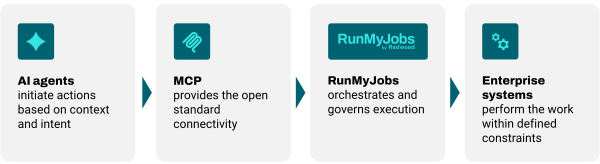
When an agent initiates an motion by MCP, RunMyJobs turns into the execution layer behind it, orchestrating that motion throughout methods, implementing dependencies, dealing with exceptions and guaranteeing each step is observable and traceable. Agent-driven actions function inside enterprise guardrails, together with the auditability and management required for SOX and different compliance frameworks.
Importantly, this works with the methods you have already got. Present workflows and enterprise logic turn into accessible to AI methods by a protocol they already perceive, together with the legacy environments you don’t intend to refactor. As an alternative of rebuilding workflows, you expose what already exists, bringing your full automation ecosystem to brokers with out migration or ranging from scratch.
The structure is easy:
Plan for what comes after agent deployment
The early phases of agent adoption are manageable. A pilot right here, a discrete use case there, people reviewing outputs earlier than something consequential occurs. What’s coming subsequent shouldn’t be.
As agent adoption scales, the problem shifts from functionality to coordination. Brokers that function independently will start to duplicate work, contradict one another and create unpredictable outcomes as they work together with the identical enterprise processes. Guide oversight gained’t scale with them.
The query is already altering from “Can we construct brokers?” to “How can we handle a whole lot of them throughout enterprise methods, in manufacturing, with accountability for each motion?”
Autonomy will evolve in phases, from human oversight to exception-based management to constrained autonomy working inside outlined guardrails. Every stage is dependent upon the identical factor: a management layer that governs how work will get carried out.
The enterprises that may get agentic AI proper aren’t ranging from scratch. They’re sitting on a long time of encoded course of intelligence, enterprise logic, compliance controls and exception dealing with that brokers must act reliably in manufacturing. Redwood has been constructing and sustaining that basis for 30 years. MCP is what makes it obtainable to the agentic period, with out dropping a single rule that took years to get proper.
Discover the technical particulars of how RunMyJobs works with MCP, or get a demo as we speak.
🔥 Supercharge your enterprise productiveness → attempt CustomGPT for customized AI brokers as we speak!

